


Foreword
In 2025, the Global Shared Services Centre (GSSC) continued to strengthen its role as a trusted and reliable service provider to the United Nations system. Throughout the year, we remained focused on delivering consistent, quality operational support that enables our partners to work more effectively in increasingly complex environments.
Our performance reflects a strong commitment to service excellence, with high levels of client satisfaction across service lines. These results are a clear indication that our efforts to listen to clients, respond to feedback, and continuously refine our services are making a meaningful difference. By maintaining close engagement with our UN partner entities and UNDP clients we have strived to better understand client needs and adapt our delivery accordingly.
At the same time, we continued to enhance the efficiency and reliability of our operations through process improvements, automation, and strengthened quality assurance. These efforts have allowed us to manage growing service demands while maintaining accuracy, timeliness, and strong internal controls.
Our partnerships also expanded during the year, reflecting continued confidence in the GSSC’s ability to deliver value. We welcomed new partner agencies while further strengthening long-standing relationships through improved transparency, clearer performance reporting, and more structured client engagement.
None of these achievements would be possible without our people. In 2025, we invested in leadership development, technical skills, and staff wellbeing, ensuring our workforce remains equipped, motivated, and aligned with our service mission.
As we move forward, the GSSC remains committed to building a more integrated, responsive, and client-focused service model—supporting the broader UN reform agenda and enabling our partners to focus on delivering impact where it matters most.

Raad Kalyana

2025 Strategic Highlights & Achievements
In 2025, the GSSC continued to deliver high-performing, scalable, and reliable operational services across the UN system. The year’s results underscore the Centre’s ability to manage large volume, mission critical transactions with speed, accuracy, and strong controls—directly enabling UNDP and partner agencies to operate more efficiently worldwide.






Our People
In 2025, the GSSC continued to strengthen its people management practices, investing in the capabilities and wellbeing of staff to ensure we serve our clients across the UN system better. These efforts were guided by staff feedback gathered through surveys, townhalls, and continuous engagement in all duty stations.
A key focus in 2025 was strengthening leadership and supervisory skills, recognizing the impact of effective management on service delivery. More than 90 managers completed the People Managers’ Role Programme, developed with the Talent Development Unit (TDU), with the emphasis on respectful leadership, clear communication and supporting staff wellbeing and growth.
We also expanded professional development opportunities to strengthen the technical and analytical skills that underpin efficient service delivery. Twenty-two personnel completed Lean Six Sigma and Green Belt certification, and career development webinars with Office of Human Resources (OHR) and TDU provided clearer pathways for staff to grow within UNDP.

Staff recognition activities were simplified and aligned across locations, celebrating contributions in service excellence, collaboration, innovation, and the use of emerging tools, including Artificial Intelligence (AI). These initiatives helped reinforce the behaviors that directly benefit our clients.
Wellbeing remained an important part of our people's strategy. Guided by survey insights and local needs, teams organized activities that support physical, mental and social wellbeing, with continued engagement from the People Wellbeing Action Groups.
As part of the corporate commitment, the GSSC delivered a comprehensive programme of PSEA awareness and capacity building across all locations, combining onsite and hybrid training, confidential consultations and refresher sessions with the Ethics Office.
2025 marked the start of preparatory work for a major optimization exercise, formally announced in 2026, as part of UNDP's wider efforts to strengthen organizational coherence and operational readiness. This work laid down the groundwork for a more streamlined and agile service delivery model, with a stronger focus on performance, accountability, and consistent service quality across all GSSC locations.
Together, these initiatives reflect the GSSC's long-term commitment to investing in its people so that we can consistently deliver strong, reliable and client-focused services across the UN system.
Industry Accreditations & Active Participations in 2025
The GSSC continues to maintain all previously obtained accreditations, which remain valid in 2025.
 CIPD Chartered Institute of Personnel and Development
 ACCA Approved Employer for Professional Development ACCA Approved Employer for Training Development (Platinum)
 CIPFA CPD Accredited Employer
 CPA Australia Recognized Employer
 CIMA Training & Development Quality Partner
HR Administration & Payroll Services
TThroughout 2025, the GSSC delivered comprehensive HR and Payroll services to more than 50,000 international, local, and non-staff personnel across more than 170 countries and territories on behalf of 62 UN partner entities. The GSSC’s Payroll and HR Administration services cover onboarding, separation, and all personal and professional events along the way. The GSSC’s HR professionals, located across nine locations, executed over 126,000 HR transactions in 2025. Throughout the year, they offered expert policy guidance and client support in Arabic, English, French and Spanish.
Notably, the GSSC successfully onboarded ICAO and WMO with Payroll services providing additional 1,200 employees with reliable and timely salary payments. Through centralized payroll management, both organizations benefit from improved efficiency and standardized procedures.
The Centre continued to offer expedited support to its clients during crisis situations. This included:
- Critical support to agencies that experienced immediate downsizing due to cut in USAID funding.
- Special measures for UNDP Programme of Assistance to the Palestinian People (UNDP/PAPP), Ukraine, Syria, Lebanon, Yemen, Haiti, Nepal, Sudan, Sri Lanka supporting speedy recruitments.






GSSC managed and administered employee benefits, compensation, and entitlements for 25,000 personnel globally, completing 106,450 transactions on behalf of UNDP and UN parnter entities, including more than 18,600 HR transactions for other UN Agencies’ personnel in more than 170 countries and territories.
Throughout 2025, continuous improvements to UNall, Quantum, and the Unified Data platform boosted data accuracy and reinforced quality assurance efforts. Enhancements to the separation workflow within UNall enabled staff to handle tasks online, creating a streamlined, paperless process. These updates helped efficiently manage a large volume of separations during the year. The launch of Data Quality and Autocheck HR Actions in Quantum further elevated the accuracy of HR processes while refined Special Leave Without Pay (SLWOP) and Special Dependency/Education Grant workflows in UNall demonstrated the Centre’s commitment to improved service delivery.
The Centre successfully concluded the annual Dependency Campaign, ensuring up‑to‑date dependency information for 16,000 local and international staff. Additionally, the team provided key support to UNFPA and UN Women during their relocation from New York to Nairobi and Bonn, and assisted WFP with the implementation of Workday Enterprise Resource Planning (ERP).
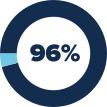
During the year, the Centre delivered comprehensive HR services to more than 13,800 PSA holders across partner agencies, including UNDP, UNCDF, UNV, UNFPA, UN Women, UNAIDS, IFAD, IMO, FAO, and ITC, and processed approximately 33,000 PSA and 4,300 PPSA-related transactions. PSA services achieved an overall 96 percent customer satisfaction rate across service lines, while the PSA team met its SLA target with a 90 percent compliance rate in 2025.
The GSSC strengthened its service delivery and partnership engagement through enhanced digital and knowledge resources. A dedicated PPSA website was launched for partner agencies, now serving over 300 active users with regularly updated guidance and essential resources. In parallel, the GSSC enhanced PSA content on its external website to further support collaboration on non-staff contractual modalities. To facilitate smooth service delivery, the team produced five instructional video guides on key PSA processes in English, French, and Spanish, all accessible through the UNall Knowledge Management platform. Internally, the team also updated its knowledge management webpage with revised standard operating procedures (SOPs) and user guides.

A significant focus during the year was the management of large-scale contract transitions resulting from evolving funding landscapes and strategic priorities. The GSSC led the termination of over 200 NPSA and IPSA contracts following the suspension of USAID funding and oversaw the transition of 77 GEF Small Grants Programme Local Individual Contract Agreements (LICAs) to NPSA across UNDP field locations and 71 UNDSS Service Contracts to NPSA contracts. To underpin service delivery efforts, the GSSC provided tailored PSA and PPSA contract templates in French and Spanish, along with agency-specific templates for UN partner entities, demonstrating flexibility and responsiveness to diverse operational requirements.

The GSSC also ensured the effective operational rollout of the revised NPSA and IPSA policies, supported by a series of targeted webinars and corresponding system configurations to enable smooth implementation across UNDP and UN partner entities.
In 2025, the GSSC Classification team achieved a 99 percent SLA compliance rate and a 99 percent client satisfaction rate, highlighting its commitment to delivering quality and reliable job classification services.
The team created a Job description and terms of reference library repository containing over 15,000 classified and validated documents since 2015, supporting the UNDP OHR HR’s AI generator initiative. Furthermore, UNall was upgraded to allow batch processing of up to 50 requests, primarily for organizational unit restructuring and realignments. Additionally, a new feature now enables the recording of International Professional (IP) staff mobility designations in UNall as well as in classification memos.

Throughout the year, the GSSC managed payroll for more than 50,000 personnel across 62 UN partner entities. The Centre successfully processed 600,000 payslips and disbursed a total of $2.3 billion, including $1.2 billion for other UN partner entities. GSSC’s Payroll team managed 12 different contract modalities.
The Centre successfully onboarded WMO and completed the induction and onboarding of ICAO, further expanding our payroll service support across UN partner entities. The GSSC also facilitated IFAD’s transition to a new medical plan, enabling a clean decoupling from the previous scheme.
In addition, the payroll team supported WFP in adopting new payroll‑related features in Quantum, including After-Service Medical Coverage (ASMC) and Separation Deferral, ensuring smooth implementation and operational readiness.
In 2025, the GSSC recorded an overall recruitment turnaround time of 83 calendar days. Of the 1,762 recruitment cases handled, 883 (47.3 percent) were completed within 70 calendar days.
Throughout the year, the GSSC Recruitment team broadened its scope: effective 1 January 2025, the team assumed full responsibility for and optimized all recruitment processes for international non-staff positions across the Central Bureaux, independent, and representation Offices. Additionally, from 1 July 2025, the recruitment portfolio was expanded to include all General Staff and regular NPSA recruitments for non-Country Office business units worldwide, including Central Bureau positions outposted to regional and country locations.
The quality of cases submitted for compliance review improved, with 61 percent of cases in 2025 having no flags, compared to 50 percent in 2024. Self-certification compliance checks for the GSSC selections began in January 2025 based on audit recommendations, improving case quality. The GSSC Recruitment Team, with OHR, started using Talent Sifting for all IP and IPSA positions in Central Bureau units.

In 2025, the GSSC held a series of training events and capacity-building initiatives to boost HR skills and promote knowledge exchange. These included regional webinars, refresher sessions, and interactive Ask Me Anything (AMA) sessions, which also covered updates on corporate system improvements and shared best practices.
Throughout the year, the GSSC conducted 12 AMA webinars for HR practitioners across Country Offices, Regional Hubs, and Headquarters. These sessions were delivered in English, French, and Spanish and took place in February, June, and November 2025. In addition, 11 workshops were held for Country Offices and UN partner entities, focusing specifically on position management and labor schedule administration.


Finance Services
Throughout 2025, the GSSC continued to support UNDP and 70 UN partner entities with timely and accurate Finance services. Over the course of the year, the Centre handled 900,000 financial transactions, amounting to more than $6.8 billion, having contributed to the operational effectiveness of UNDP and its clients around the globe.
A dedicated team of finance professionals based in Kuala Lumpur, together with three Regional Service Centres, managed cash inflows, supplier transactions, and payment services across more than 170 countries and territories, while providing daily support to UNDP Country Offices seeking assistance with specific financial transactions.
The Centre also continued to provide accelerated services in emergency, crisis, and complex settings, completing 15,662 financial transactions for crisis countries, including Bangladesh, Haiti, Lebanon, Niger, State of Palestine, Sudan, Syria, Ukraine and Yemen. With a satisfaction rate of 97 percent. The GSSC also updated the Emergency SOP to streamline and prioritize responses to conflict and emergency cases, enabling faster and more efficient processing.


Emergency Support: Crisis & Post-Crisis Countries

In 2025, the GSSC strengthened its role as an enabler of UNDP’s crisis response by ensuring operational continuity and rapid support to offices working in fragile, conflict affected, and postcrisis contexts. More than 15,000 financial transactions were processed for crisis affected countries such as Haiti, Sudan, and Ukraine. In addition, 270 HR and recruitment support requests were fast tracked to maintain ongoing operations and enable timely deployment of surge capacity when required.
The GSSC also provided specialized support to UN partner entities facing urgent organizational restructuring, including downsizing triggered by significant reductions in external funding. This ensured the continuity of essential administrative and HR services during periods of major institutional transition.
Across service lines, the GSSC activated special operational measures for crisis affected countries including the State of Palestine, Ukraine, Syria, Lebanon, Yemen, Haiti, Nepal, Sudan, and Sri Lanka. These measures enabled accelerated recruitment processes to facilitate the rapid mobilization of critical personnel. A good example was the Competitive Selection Exercise conducted for Yemen in December 2025, where the Recruitment team achieved an average turnaround time of 16 calendar days, demonstrating the Centre’s ability to deliver timely results under urgent conditions.
The Classification team contributed to crisis preparedness by approving and pre classifying 171 generic job descriptions and terms of reference for the Crisis Bureau. These resources span a broad range of crisis and early recovery functions—from debris management and livelihoods recovery to strengthening local governance, advancing gender equality, and supporting essential services such as health, energy, and community security. All reclassified templates are now accessible through the Early Recovery Hub, providing Country Offices with ready to use resources designed for rapid deployment.
To further strengthen responsiveness to crisis contexts, the GSSC updated its Emergency SOP, streamlining the prioritisation and handling of cases from conflict affected Country Offices and other emergency situations. These improvements enabled faster decision making and more efficient processing during periods of heightened operational pressure.



• 53 accounts transitioned to automated reconciliation
• New dashboards improved detection of unposted transactions

Looking Ahead & Future Priorities
In 2026, the GSSC will advance a strategic agenda centered on delivering more unified, efficient, and client-focused shared services across the UN system. Guided by the UNDP Strategic Plan 2026–2029 and the UN80 reform vision, the Centre will emphasize systemwide consolidation, harmonization, and performance excellence to better support partner agencies operating in increasingly complex environments.

A priority for the coming year is expanding interagency shared services in core operational areas — Finance, Payroll, and HR Administration. The GSSC will work to ensure agencies benefit from predictable, high-quality, and interoperable services.
To reinforce financial sustainability and transparency, the GSSC will implement Phase II of the cost recovery model, extending structured pricing to Recruitment, Classification, and Finance services. This will provide clients with more consistent costing, and greater visibility into the value and scope of services received. Strengthened communication and client briefings will support partners through the transition and reinforce trust in the shared‑services model.
Improved data transparency and performance management will remain central to strengthening client experience. Enhanced dashboards, real‑time operational insights, and upgraded SLAs will give agencies clearer visibility into service delivery trends, enabling faster, evidence‑based decision‑making.
Supporting UN80 system harmonization, the GSSC will collaborate with other business units to further expand the Quantum consortium, reducing fragmentation of administrative platforms and enabling more seamless, multiservice delivery for UN entities.
Together, these priorities position the GSSC to deliver a more integrated, scalable, and client‑centric service ecosystem—reducing administrative burden, improving operational predictability, and supporting the UN system to focus resources where they matter most: programme impact.
Learn more about how the GSSC delivers quality, timely services in support of the UN’s efficiency and effectiveness agenda and to advance sustainable development. Download our GSSC services overview two-pager and HR Administration, Payroll and Finance one pagers.
Photo credits:
© UNV, 2019 · © UNFPA Nepal / Luis Tato, 2023 · © IARC, 2024 · © UN Women / Ryan Brown · © FAO · © UNDP, 2025 · © WMO, 2024